
InVivoMAb anti-mouse PD-1 (CD279)
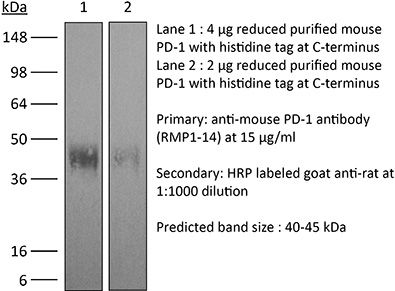
Product Description
Specifications
| Isotype | Rat IgG2a, κ |
|---|---|
| Recommended Isotype Control(s) | InVivoMAb rat IgG2a isotype control, anti-trinitrophenol |
| Recommended Dilution Buffer | InVivoPure pH 7.0 Dilution Buffer |
| Conjugation | This product is unconjugated. Conjugation is available via our Antibody Conjugation Services. |
| Immunogen | Syrian Hamster BKH cells transfected with mouse PD-1 cDNA |
| Reported Applications |
in vivo blocking of PD-1/PD-L signaling in vitro Organoids/Organ-on-Chip |
| Formulation |
PBS, pH 7.0 Contains no stabilizers or preservatives |
| Endotoxin |
≤1EU/mg (≤0.001EU/μg) Determined by LAL assay |
| Purity |
≥95% Determined by SDS-PAGE |
| Sterility | 0.2 µm filtration |
| Production | Purified from cell culture supernatant in an animal-free facility |
| Purification | Protein G |
| RRID | AB_10949053 |
| Molecular Weight | 150 kDa |
| Storage | The antibody solution should be stored at the stock concentration at 4°C. Do not freeze. |
| Need a Custom Formulation? | See All Antibody Customization Options |
Product Citations
-
Potential treatment benefits of a GLP-1R antagonist in combination with immune checkpoint inhibitors in colorectal cancer.
In Oncol Lett on 1 April 2026 by Zhan, Z., Zhan, C., et al.
PubMed
The clinical efficacy of immune checkpoint inhibitors (ICIs) in colorectal cancer (CRC) remains limited. Modulation of the glucagon-like peptide-1 receptor (GLP-1R) may enhance T-cell-mediated antitumor responses. The present study aimed to evaluate the antitumor effects of the GLP-1R antagonist Exendin 9-39 (Exe-9) combined with anti-programmed cell death protein-1 (PD-1) treatment in preclinical CRC models. Using in vitro co-culture assays, ELISA and in vivo murine models, alongside immunohistochemical and molecular analyses of clinical samples, HT-29 and MC38-OVA colon cancer cell lines were co-cultured in vitro with activated T cells in the presence of Exe-9. In vivo, male BALB/c mice were injected with MC38 to establish a CRC model and nude mice were used to assess T-cell dependency. To evaluate this synergistic effect, BALB/c mice with CRC were treated with Exe-9, anti-PD-1 or a combination. Additionally, clinical CRC samples were analyzed to assess the association of GLP-1R expression with the immunotherapy response. Exe-9 significantly enhanced T-cell-mediated cytotoxicity in CRC cell lines and reduced tumor growth in immunocompetent CRC mice; however, this effect was not observed in nude mice. Furthermore, combination therapy with the GLP-1R antagonist and anti-PD-1 yielded an improved antitumor effect compared with either treatment alone, and high GLP-1R ex2pression in clinical samples correlated with poor ICI response. These findings suggest that GLP-1R antagonism potentiates T-cell-mediated antitumor immunity and may provide a promising adjunctive therapeutic strategy for patients with CRC when combined with ICIs in the future.
-
Nintedanib enhances the antitumor efficacy of pd-1 blockade, potentially through inhibition of myeloid-derived suppressor cells and cancer-associated fibroblasts.
In Cancer Immunol Immunother on 5 March 2026 by Suzuki, R., Watanabe, S., et al.
PubMed
Although programmed cell death-1 (PD-1) inhibitors have shown promising and durable responses in patients with several types of cancer, many patients show resistance to PD-1 inhibitors. Recent evidence has demonstrated that immunosuppressive cells are induced in tumor microenvironment and inhibit the anti-tumor effects of anti-PD-1 monoclonal antibody (αPD-1 mAb). To investigate whether nintedanib-a multi-tyrosine kinase inhibitor targeting vascular endothelial growth factor receptor, fibroblast growth factor receptor, and platelet-derived growth factor receptor-suppresses immunosuppressive cells and enhances the anti-tumor effects of αPD-1 mAb in preclinical models, flowcytometry, immunohistochemistry, and RNA sequencing of tumor-tissue, tumor-draining lymph nodes, spleens were conducted. RNA sequencing of murine tumor tissues revealed that nintedanib decreased the gene signatures related to myeloid-derived suppressor cells (MDSCs) and cancer-associated fibroblasts (CAFs). Flow cytometry showed that nintedanib significantly decreased the MDSC and CAF percentage in tumor-bearing hosts and increased IFN-ϒ+CD4+ and CD8+ T cells infiltrating into tumors. Immunohistochemical analysis demonstrated that nintedanib treatment significantly increased the number of CD8+ T cells in the internal area of the tumor. Adding nintedanib to anti-PD-1 mAb therapy significantly inhibited in vivo tumor progression. These results indicate that nintedanib suppresses MDSCs and CAFs by inhibiting VEGFR-, PDGFR-, and FGFR-mediated signaling, thereby increasing effector T-cell infiltration into tumors and enhancing the anti-tumor effects of αPD-1 mAb therapy.
-
T-cell Priming by High-Avidity Neoantigens in Lymph Nodes Augments Adoptive Immunotherapy.
In Cancer Immunol Res on 4 March 2026 by Wittling, M. C., Rivera Reyes, A. M., et al.
PubMed
Adoptive transfer of T lymphocytes specific for neoantigens can elicit immunity against solid tumors in patients. However, how these antigens affect T-cell function, effector differentiation, and persistence remains unclear. We examined how an identical CD8+ T-cell product was shaped by melanoma expressing either a low-avidity self/tumor-associated antigen or high-avidity neoantigen and kinetically profiled T-cell differentiation in these two contexts across host tissues. High-avidity neoantigen expression was sufficient to activate naïve CD8+ T cells-leading to robust tumor regression and long-term protective immunity upon tumor rechallenge. Mechanistically, transferred naïve CD8+ T cells reacting to high-avidity neoantigen exhibited enhanced cytokine production, heightened effector function, and sustained persistence compared with the low-avidity wild-type tumors. Antitumor activity to these high-avidity tumors was preserved even in the absence of functional host T and B lymphocytes, and early lymph node (LN) trafficking was found to be essential for adoptive T-cell therapy efficacy. Expanded effector or stem memory T cells were compared with the naïve pmel-1 T-cell product. Stem memory (but not effector memory) cells exhibited similar antitumor efficacy and LN trafficking patterns to the naïve cells in mice with high-avidity neoantigen-expressing tumors. These findings highlight how differential tumor antigens shape divergent cellular fate and uncover a critical role of T-cell trafficking in LNs in shaping high-avidity neoantigen-specific responses.
-
ACT001 synergizes with temozolomide-based chemoradiotherapy to cure refractory glioblastoma by targeting TNF-CXCL10-CD8+ T-cell immunity.
In Front Pharmacol on 2 March 2026 by Shu, Y., Ding, Z. H., et al.
PubMed
Glioblastoma multiforme (GBM), a highly invasive brain tumor, is severely restricted in T-cell infiltration and anti-tumor activity due to its immunosuppressive microenvironment. However, commonly used preclinical GBM mouse models cannot fully recapitulate the refractoriness of human GBM or effectively distinguish therapeutic efficacy. In this study, we evaluated the efficacy and mechanisms of therapies based on the novel sesquiterpene lactone small-molecule compound, ACT001, using the refractory G422TN-GBM mouse model. ACT001 alone exerted evident anti-G422TN-GBM effects in vivo and in vitro, but it only slightly prolonged animal survival. ACT001 combined with concurrent radiotherapy and temozolomide (RT/TMZ) exerted synergistic effects by suppressing tumor progression and extending animal survival. Importantly, the RT/TMZ/ACT001 regimen could achieve cure (long-term survival, >100 d, 26.7%) and immune cure (passing the tumor-rechallenge assay, >100 d, 12.5%) in G422TN mice. However, combining the anti-PD-1 antibody (αPD-1) with RT/TMZ/ACT001 did not further improve survival. Mechanistically, RT/TMZ/ACT001 substantially activated the tumor necrosis factor (TNF) pathway, inducing tumor cells and stromal cells in the microenvironment to express the chemokine C-X-C motif chemokine 10 (CXCL10), thereby promoting T-cell infiltration, especially CD8+ T cell, into the tumor site. Pharmacological inhibition of the TNF signaling pathway with R-7050 completely abolished the synergistic efficacy of RT/TMZ/ACT001. Taken together, our results demonstrate that ACT001 combined with RT/TMZ can overcome the immunosuppressive barrier of GBM to achieve immune cure in GBM via TNF-CXCL10-CD8+ signaling, strongly suggesting the priority of combining ACT001 with RT/TMZ rather than with αPD-1 in clinical trials.