
InVivoMAb anti-mouse PD-L1 (B7-H1)
Product Description
Specifications
| Isotype | Rat IgG2b, κ |
|---|---|
| Recommended Isotype Control(s) | InVivoMAb rat IgG2b isotype control, anti-keyhole limpet hemocyanin |
| Recommended Dilution Buffer | InVivoPure pH 6.5 Dilution Buffer |
| Conjugation | This product is unconjugated. Conjugation is available via our Antibody Conjugation Services. |
| Immunogen | Mouse CD274 |
| Reported Applications |
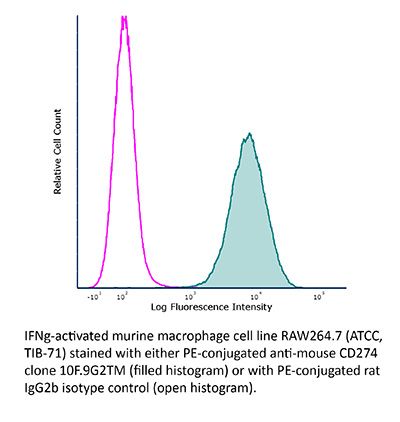
in vivo PD-L1 blockade in vitro PD-L1 blockade Immunofluorescence Immunohistochemistry (frozen) Flow cytometry Western blot in vitro Organoids/Organ-on-Chip |
| Formulation |
PBS, pH 6.5 Contains no stabilizers or preservatives |
| Endotoxin |
≤1EU/mg (≤0.001EU/μg) Determined by LAL assay |
| Purity |
≥95% Determined by SDS-PAGE |
| Sterility | 0.2 µm filtration |
| Production | Purified from cell culture supernatant in an animal-free facility |
| Purification | Protein G |
| RRID | AB_10949073 |
| Molecular Weight | 150 kDa |
| Storage | The antibody solution should be stored at the stock concentration at 4°C. Do not freeze. |
| Need a Custom Formulation? | See All Antibody Customization Options |
Application References
-
Deng, L., et al (2014). "Irradiation and anti-PD-L1 treatment synergistically promote antitumor immunity in mice" J Clin Invest 124(2): 687-695.
PubMed
High-dose ionizing irradiation (IR) results in direct tumor cell death and augments tumor-specific immunity, which enhances tumor control both locally and distantly. Unfortunately, local relapses often occur following IR treatment, indicating that IR-induced responses are inadequate to maintain antitumor immunity. Therapeutic blockade of the T cell negative regulator programmed death-ligand 1 (PD-L1, also called B7-H1) can enhance T cell effector function when PD-L1 is expressed in chronically inflamed tissues and tumors. Here, we demonstrate that PD-L1 was upregulated in the tumor microenvironment after IR. Administration of anti-PD-L1 enhanced the efficacy of IR through a cytotoxic T cell-dependent mechanism. Concomitant with IR-mediated tumor regression, we observed that IR and anti-PD-L1 synergistically reduced the local accumulation of tumor-infiltrating myeloid-derived suppressor cells (MDSCs), which suppress T cells and alter the tumor immune microenvironment. Furthermore, activation of cytotoxic T cells with combination therapy mediated the reduction of MDSCs in tumors through the cytotoxic actions of TNF. Our data provide evidence for a close interaction between IR, T cells, and the PD-L1/PD-1 axis and establish a basis for the rational design of combination therapy with immune modulators and radiotherapy.
-
Zander, R. A., et al (2015). "PD-1 Co-inhibitory and OX40 Co-stimulatory Crosstalk Regulates Helper T Cell Differentiation and Anti-Plasmodium Humoral Immunity" Cell Host Microbe 17(5): 628-641.
PubMed
The differentiation and protective capacity of Plasmodium-specific T cells are regulated by both positive and negative signals during malaria, but the molecular and cellular details remain poorly defined. Here we show that malaria patients and Plasmodium-infected rodents exhibit atypical expression of the co-stimulatory receptor OX40 on CD4 T cells and that therapeutic enhancement of OX40 signaling enhances helper CD4 T cell activity, humoral immunity, and parasite clearance in rodents. However, these beneficial effects of OX40 signaling are abrogated following coordinate blockade of PD-1 co-inhibitory pathways, which are also upregulated during malaria and associated with elevated parasitemia. Co-administration of biologics blocking PD-1 and promoting OX40 signaling induces excessive interferon-gamma that directly limits helper T cell-mediated support of humoral immunity and decreases parasite control. Our results show that targeting OX40 can enhance Plasmodium control and that crosstalk between co-inhibitory and co-stimulatory pathways in pathogen-specific CD4 T cells can impact pathogen clearance.
-
Hafalla, J. C., et al (2012). "The CTLA-4 and PD-1/PD-L1 inhibitory pathways independently regulate host resistance to Plasmodium-induced acute immune pathology" PLoS Pathog 8(2): e1002504.
PubMed
The balance between pro-inflammatory and regulatory immune responses in determining optimal T cell activation is vital for the successful resolution of microbial infections. This balance is maintained in part by the negative regulators of T cell activation, CTLA-4 and PD-1/PD-L, which dampen effector responses during chronic infections. However, their role in acute infections, such as malaria, remains less clear. In this study, we determined the contribution of CTLA-4 and PD-1/PD-L to the regulation of T cell responses during Plasmodium berghei ANKA (PbA)-induced experimental cerebral malaria (ECM) in susceptible (C57BL/6) and resistant (BALB/c) mice. We found that the expression of CTLA-4 and PD-1 on T cells correlates with the extent of pro-inflammatory responses induced during PbA infection, being higher in C57BL/6 than in BALB/c mice. Thus, ECM develops despite high levels of expression of these inhibitory receptors. However, antibody-mediated blockade of either the CTLA-4 or PD-1/PD-L1, but not the PD-1/PD-L2, pathways during PbA-infection in ECM-resistant BALB/c mice resulted in higher levels of T cell activation, enhanced IFN-gamma production, increased intravascular arrest of both parasitised erythrocytes and CD8(+) T cells to the brain, and augmented incidence of ECM. Thus, in ECM-resistant BALB/c mice, CTLA-4 and PD-1/PD-L1 represent essential, independent and non-redundant pathways for maintaining T cell homeostasis during a virulent malaria infection. Moreover, neutralisation of IFN-gamma or depletion of CD8(+) T cells during PbA infection was shown to reverse the pathologic effects of regulatory pathway blockade, highlighting that the aetiology of ECM in the BALB/c mice is similar to that in C57BL/6 mice. In summary, our results underscore the differential and complex regulation that governs immune responses to malaria parasites.
-
Dietze, K. K., et al (2013). "Combining regulatory T cell depletion and inhibitory receptor blockade improves reactivation of exhausted virus-specific CD8+ T cells and efficiently reduces chronic retroviral loads" PLoS Pathog 9(12): e1003798.
PubMed
Chronic infections with human viruses, such as HIV and HCV, or mouse viruses, such as LCMV or Friend Virus (FV), result in functional exhaustion of CD8(+) T cells. Two main mechanisms have been described that mediate this exhaustion: expression of inhibitory receptors on CD8(+) T cells and expansion of regulatory T cells (Tregs) that suppress CD8(+) T cell activity. Several studies show that blockage of one of these pathways results in reactivation of CD8(+) T cells and partial reduction in chronic viral loads. Using blocking antibodies against PD-1 ligand and Tim-3 and transgenic mice in which Tregs can be selectively ablated, we compared these two treatment strategies and combined them for the first time in a model of chronic retrovirus infection. Blocking inhibitory receptors was more efficient than transient depletion of Tregs in reactivating exhausted CD8(+) T cells and reducing viral set points. However, a combination therapy was superior to any single treatment and further augmented CD8(+) T cell responses and resulted in a sustained reduction in chronic viral loads. These results demonstrate that Tregs and inhibitory receptors are non-overlapping factors in the maintenance of chronic viral infections and that immunotherapies targeting both pathways may be a promising strategy to treat chronic infectious diseases.
Product Citations
-
Flt3L-mediated tumor cDC1 expansion enhances immunotherapy by priming stem-like CD8+ T cells in lymph nodes.
In Nat Immunol on 1 March 2026 by Lai, J., Chan, C. W., et al.
PubMed
Immune checkpoint blockade (ICB) evokes antitumor immunity through the reinvigoration of T cell responses. T cell differentiation status controls response, with less differentiated cells having an enhanced capacity to proliferate after ICB. Given that conventional type 1 dendritic cells (cDC1) maintain precursor exhausted T cells (TPEX), we hypothesized that expansion of cDC1s with Flt3L could enhance responses to ICB. Here we show that treatment with Fms-related tyrosine kinase 3 ligand (Flt3L) expands CD62L+SLAMF6+CD8+ T cells in the tumor through a mechanism that requires XCR1+ dendritic cells to traffic to the tumor-draining lymph node. The combination of Flt3L and anti-CTLA-4 enhanced therapeutic responses. Combination therapy is associated with the emergence of a CD8+ T cell subset characterized by the expression of Il21r and oligoclonal expansion of CD8+ T cells within tumors through a mechanism that is dependent on lymph node egress.
-
Inhibiting ADAR1-Mediated Excessive Epigenetic A-to-I RNA Editing Improves the Immune Microenvironment and Increases Sensitivity to Immunotherapy in Lung Adenocarcinoma.
In MedComm (2020) on 1 March 2026 by Wang, S., Zheng, S., et al.
PubMed
Adenosine-to-inosine (A-to-I) RNA editing, predominantly catalyzed by the enzyme adenosine deaminase acting on RNA 1 (ADAR1), has attracted interest due to its essential functions in regulating immune response and cancer progression. This research investigates ADAR1 inhibition as a promising strategy aimed at improving immunotherapy efficacy in lung adenocarcinoma (LUAD) and explores the underlying mechanisms. Findings from murine models demonstrate that ADAR1 suppression within tumors notably improves the immune microenvironment, marked by increased PD-L1 expression and enhanced CD8+ T-cell infiltration, as well as elevated levels of CXCL9, CXCL10, and CXCL11. These changes promote antitumor T-cell immune responses and amplify the effects of immunotherapy. Mechanistic investigations further reveal that deficiency in ADAR1 leads to an increase in double-stranded RNA (dsRNA), which serves as a substrate for A-to-I editing. This activates downstream signaling via dsRNA receptors, including RIG-I and MAVS, thereby inducing the IFN-β pathway. Significantly, IFN-β contributes to the ADAR1-dependent modulation of the tumor immune microenvironment and carcinogenesis in LUAD. Clinical validation in LUAD patients further confirms that reduced ADAR1 expression is associated with improved immunotherapy responses. These findings suggest inhibiting ADAR1-mediated A-to-I RNA editing is a promising approach to enhance the efficacy of immunotherapy in LUAD.
-
Tumor-intrinsic ETV5 expression promotes PMN-MDSC-mediated immune evasion and immune checkpoint inhibitor resistance by activating the JAK2/STAT3/CCL2 axis.
In Oncogene on 1 March 2026 by Yin, T. T., Huang, M. X., et al.
PubMed
Immunotherapy remains ineffective for a wide variety of solid tumors due to the existence of tumor immune evasion. Although the transcription factor ETV5 is recognized for its oncogenic roles in tumor progression, its role in remodeling the immunosuppressive microenvironment remains largely unexplored. Here, we reveal that tumor-intrinsic ETV5 drives immune evasion and immune checkpoint inhibitor (ICI) resistance by enhancing the expansion and recruitment of polymorphonuclear myeloid-derived suppressor cells (PMN-MDSCs). Genetic silencing of ETV5 in murine tumor models suppressed PMN-MDSCs differentiation from myeloid progenitors, reduced their tumor infiltration, and attenuated immunosuppressive function, resulting in enhanced cytotoxic T cell activity and delayed tumor progression. Mechanistically, ETV5 directly binds to the JH1 domain of JAK2, inducing its dimerization and phosphorylation, which activates STAT3 to transcriptionally upregulate CCL2 and recruit PMN-MDSCs. Therapeutically, ETV5 ablation synergized with anti-PD-L1 therapy to enhance tumor control, mirroring clinical observations where high ETV5 expression predicted immunotherapy resistance. Our study uncovers a non-canonical, transcription-independent role of ETV5 in orchestrating the JAK2/STAT3/CCL2 axis to sustain PMN-MDSC-mediated immune evasion, proposing ETV5 as a druggable target to overcome ICI resistance in solid tumors.
-
Mesothelioma location influences the tumour microenvironment and immune checkpoint therapy response in preclinical models.
In Sci Rep on 25 February 2026 by Orozco Morales, M. L., Lansley, S. M., et al.
PubMed