
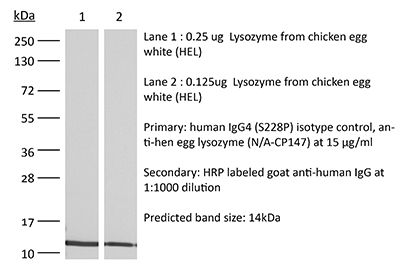
RecombiMAb human IgG4 (S228P) isotype control, anti-hen egg lysozyme
Product Description
Note: This product was previously sold as catalog number BE0349 and is identical to the product previously sold as BE0349.
Specifications
| Isotype | Human IgG4, κ |
|---|---|
| Recommended Dilution Buffer | InVivoPure pH 7.0 Dilution Buffer |
| Conjugation | This product is unconjugated. Conjugation is available via our Antibody Conjugation Services. |
| Mutations | S228P |
| Immunogen | Hen egg lysozyme (HEL) |
| Formulation |
PBS, pH 7.0 Contains no stabilizers or preservatives |
| Endotoxin |
≤0.5EU/mg (≤0.0005EU/μg) Determined by LAL assay |
| Aggregation |
<5% Determined by SEC |
| Purity |
≥95% Determined by SDS-PAGE |
| Sterility | 0.2 µm filtration |
| Production | Purified from CHO cell supernatant in an animal-free facility |
| Purification | Protein A |
| RRID | AB_2894768 |
| Molecular Weight | 150 kDa |
| Murine Pathogen Tests |
Ectromelia/Mousepox Virus: Negative Hantavirus: Negative K Virus: Negative Lactate Dehydrogenase-Elevating Virus: Negative Lymphocytic Choriomeningitis virus: Negative Mouse Adenovirus: Negative Mouse Cytomegalovirus: Negative Mouse Hepatitis Virus: Negative Mouse Minute Virus: Negative Mouse Norovirus: Negative Mouse Parvovirus: Negative Mouse Rotavirus: Negative Mycoplasma Pulmonis: Negative Pneumonia Virus of Mice: Negative Polyoma Virus: Negative Reovirus Screen: Negative Sendai Virus: Negative Theiler’s Murine Encephalomyelitis: Negative |
| Storage | The antibody solution should be stored at the stock concentration at 4°C. Do not freeze. |
| Need a Custom Formulation? | See All Antibody Customization Options |
Product Citations
-
Ibrutinib and PD-1 Blockade Potentiate Mesothelin-Targeting CAR T-cell Therapy in Preclinical Models of Pancreatic Cancer.
In Clin Cancer Res on 4 February 2026 by Armstrong, A., van der Plancke, G., et al.
PubMed
Pancreatic ductal adenocarcinoma (PDAC) remains refractory to chimeric antigen receptor (CAR) T-cell therapies because of its immunosuppressive microenvironment and a dense extracellular matrix deposited by cancer-associated fibroblasts (CAF), which impair CAR T-cell infiltration. To address these barriers, we previously developed a dual-targeting CAR-TEAM platform in which mesothelin-specific CAR T cells secrete a fibroblast activation protein (FAP)-targeting T-cell engager antibody molecule (TEAM) to simultaneously kill tumor cells and CAF. In this study, we leveraged mesothelin-targeting CAR T cells and tested rational drug combinations and optimal delivery strategies to enhance therapeutic efficacy and guide potential combinations that could be incorporated into a clinical study.
-
IL-15 Superagonist SHR-1501 Enhances Immune Responses in Lung Cancer by Modulating Tumor Microenvironment.
In Clin Respir J on 1 August 2025 by Zhang, Q., Hu, C., et al.
PubMed
Interleukin-15 (IL-15) is a pleiotropic cytokine recognized as a promising therapeutic agent in cancer immunotherapy. IL-15 superagonists have shown efficacy across various cancers, yet their effects in lung cancer immunotherapy remain underexplored.
-
Early NK-cell and T-cell dysfunction marks progression to severe dengue in patients with obesity and healthy weight.
In Nat Commun on 1 July 2025 by Gregorova, M., Santopaolo, M., et al.
PubMed
Dengue is a mosquito-borne virus infection affecting half of the world's population for which therapies are lacking. The role of T and NK-cells in protection/immunopathogenesis remains unclear for dengue. We performed a longitudinal phenotypic, functional and transcriptional analyses of T and NK-cells in 124 dengue patients using flow cytometry and single-cell RNA-sequencing. We show that T/NK-cell signatures early in infection discriminate patients who develop severe dengue (SD) from those who do not. These signatures are exacerbated in patients with overweight/obesity compared to healthy weight patients, supporting their increased susceptibility to SD. In SD, CD4+/CD8+ T-cells and NK-cells display increased co-inhibitory receptor expression and decreased cytotoxic potential compared to non-SD. Using transcriptional and proteomics approaches we show decreased type-I Interferon responses in SD, suggesting defective innate immunity may underlie NK/T-cell dysfunction. We propose that dysfunctional T and NK-cell signatures underpin dengue pathogenesis and may represent novel targets for immunomodulatory therapy in dengue.
-
Inflammatory arthritis immune related adverse events represent a unique autoimmune disease entity primarily driven by T cells, but likely not autoantibodies
In medRxiv on 6 June 2025 by Zhu, X., Yu, Y., et al.