
InVivoMAb anti-mouse/human/rat/monkey/hamster/canine/bovine TGF-β
in vitro TGFβ neutralization
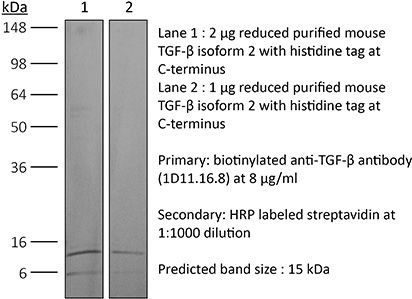
Western blot
Product Description
Specifications
| Isotype | Mouse IgG1, κ |
|---|---|
| Recommended Isotype Control(s) | InVivoMAb mouse IgG1 isotype control, unknown specificity |
| Recommended Dilution Buffer | InVivoPure pH 7.0 Dilution Buffer |
| Conjugation | This product is unconjugated. Conjugation is available via our Antibody Conjugation Services. |
| Immunogen | Bovine TGFβ isoform 2 |
| Reported Applications |
in vivo TGFβ neutralization in vitro TGFβ neutralization Western blot |
| Formulation |
PBS, pH 7.0 Contains no stabilizers or preservatives |
| Endotoxin |
≤1EU/mg (≤0.001EU/μg) Determined by LAL assay |
| Purity |
≥95% Determined by SDS-PAGE |
| Sterility | 0.2 µm filtration |
| Production | Purified from cell culture supernatant in an animal-free facility |
| Purification | Protein G |
| RRID | AB_1107757 |
| Molecular Weight | 150 kDa |
| Storage | The antibody solution should be stored at the stock concentration at 4°C. Do not freeze. |
| Need a Custom Formulation? | See All Antibody Customization Options |
Application References
-
Leon, B., et al (2014). "FoxP3+ regulatory T cells promote influenza-specific Tfh responses by controlling IL-2 availability" Nat Commun 5: 3495.
PubMed
Here, we test the role of FoxP3(+) regulatory T cells (Tregs) in controlling T follicular helper (Tfh) and germinal centre (GC) B-cell responses to influenza. In contrast to the idea that Tregs suppress T-cell responses, we find that Treg depletion severely reduces the Tfh cell response to influenza virus. Furthermore, Treg depletion prevents the accumulation of influenza-specific GCs. These effects are not due to alterations in TGFbeta availability or a precursor-progeny relationship between Tregs and Tfh cells, but are instead mediated by increased availability of IL-2, which suppresses the differentiation of Tfh cells and as a consequence, compromises the GC B response. Thus, Tregs promote influenza-specific GC responses by preventing excessive IL-2 signalling, which suppresses Tfh cell differentiation.
-
Choi, Y. S., et al (2015). "LEF-1 and TCF-1 orchestrate TFH differentiation by regulating differentiation circuits upstream of the transcriptional repressor Bcl6" Nat Immunol 16(9): 980-990.
PubMed
Follicular helper T cells (TFH cells) are specialized effector CD4(+) T cells that help B cells develop germinal centers (GCs) and memory. However, the transcription factors that regulate the differentiation of TFH cells remain incompletely understood. Here we report that selective loss of Lef1 or Tcf7 (which encode the transcription factor LEF-1 or TCF-1, respectively) resulted in TFH cell defects, while deletion of both Lef1 and Tcf7 severely impaired the differentiation of TFH cells and the formation of GCs. Forced expression of LEF-1 enhanced TFH differentiation. LEF-1 and TCF-1 coordinated such differentiation by two general mechanisms. First, they established the responsiveness of naive CD4(+) T cells to TFH cell signals. Second, they promoted early TFH differentiation via the multipronged approach of sustaining expression of the cytokine receptors IL-6Ralpha and gp130, enhancing expression of the costimulatory receptor ICOS and promoting expression of the transcriptional repressor Bcl6.
-
Bodogai, M., et al (2015). "Immunosuppressive and Prometastatic Functions of Myeloid-Derived Suppressive Cells Rely upon Education from Tumor-Associated B Cells" Cancer Res 75(17): 3456-3465.
PubMed
Myeloid-derived suppressive cells (MDSC) have been reported to promote metastasis, but the loss of cancer-induced B cells/B regulatory cells (tBreg) can block metastasis despite MDSC expansion in cancer. Here, using multiple murine tumor models and human MDSC, we show that MDSC populations that expand in cancer have only partially primed regulatory function and limited prometastatic activity unless they are fully educated by tBregs. Cancer-induced tBregs directly activate the regulatory function of both the monocyte and granulocyte subpopulations of MDSC, relying, in part, on TgfbetaR1/TgfbetaR2 signaling. MDSC fully educated in this manner exhibit an increased production of reactive oxygen species and NO and more efficiently suppress CD4(+) and CD8(+) T cells, thereby promoting tumor growth and metastasis. Thus, loss of tBregs or TgfbetaR deficiency in MDSC is sufficient to disable their suppressive function and to block metastasis. Overall, our data indicate that cancer-induced B cells/B regulatory cells are important regulators of the immunosuppressive and prometastatic functions of MDSC.
-
Clemente-Casares, X., et al (2016). "Expanding antigen-specific regulatory networks to treat autoimmunity" Nature 530(7591): 434-440.
PubMed
Regulatory T cells hold promise as targets for therapeutic intervention in autoimmunity, but approaches capable of expanding antigen-specific regulatory T cells in vivo are currently not available. Here we show that systemic delivery of nanoparticles coated with autoimmune-disease-relevant peptides bound to major histocompatibility complex class II (pMHCII) molecules triggers the generation and expansion of antigen-specific regulatory CD4(+) T cell type 1 (TR1)-like cells in different mouse models, including mice humanized with lymphocytes from patients, leading to resolution of established autoimmune phenomena. Ten pMHCII-based nanomedicines show similar biological effects, regardless of genetic background, prevalence of the cognate T-cell population or MHC restriction. These nanomedicines promote the differentiation of disease-primed autoreactive T cells into TR1-like cells, which in turn suppress autoantigen-loaded antigen-presenting cells and drive the differentiation of cognate B cells into disease-suppressing regulatory B cells, without compromising systemic immunity. pMHCII-based nanomedicines thus represent a new class of drugs, potentially useful for treating a broad spectrum of autoimmune conditions in a disease-specific manner.
Product Citations
-
Enhanced glioblastoma immunotherapy via SMAC mimetic dose escalation and TGFβ blockade.
In Neurooncol Adv on 16 February 2026 by Malone, K., Dugas, M., et al.
PubMed
Glioblastoma (GBM) is the most common primary brain tumor with an overall survival under 21 months. Despite extensive research effort, patient outcomes have improved minimally over the past several decades. The Inhibitor of Apoptosis (IAP) proteins are critical survival factors implicated in both immune regulation and gliomagenesis. Small molecule IAP antagonists called SMAC mimetic compounds (SMCs) are under investigation as cancer therapeutics across multiple malignancies, including GBM. SMCs induce GBM cell death in the presence of inflammatory cytokines, synergize with immune checkpoint inhibitors (ICI), and induce death of microglia and macrophages. Although SMCs show significant efficacy in murine models, complete eradication is not achieved. Here, we aimed to understand the limitations of SMCs in murine GBM and identify strategies to enhance efficacy of combination treatment with ICIs with the goal of informing future translational efforts.
-
Galectin7 attenuates abdominal aortic aneurysm progression by resisting disturbed flow induced endothelial-to-mesenchymal transition.
In Theranostics on 29 January 2026 by Wang, Y., Zhou, Y., et al.
PubMed
Background: The switch to endothelial-to-mesenchymal transition (EndMT) in endothelial cells (ECs) induced by disturbed flow (d-flow) has been identified as the critical driver of the pathogenesis of inflammatory vascular disorders. We aimed to investigate the role of EndMT in abdominal aortic aneurysms (AAA) and the underlying mechanism. Methods: Immunoblotting, immunofluorescence and transmission electron microscope were used to assess d-flow-induced EndMT in human and mouse AAA models (Ang II/PPE). An Ibidi pump system was used to produce d-flow on human aortic endothelial cells (HAECs), and the expression of galectin-7 was enhanced and weakened using an adeno-associated virus. Furthermore, single-cell RNA sequencing was performed to explore the underlying mechanism of galectin-7-mediated EndMT. Results: EndMT induced by d-flow, which suppressed galectin-7 expression, was positively correlated with AAA. Enhanced galectin-7 expression inhibited d-flow-induced EndMT and AAA progression, whereas reduced galectin-7 expression resulted in the opposite effect. Mechanistically, we found a EndMT-related cluster in HAECs by single-cell RNA sequencing, and the SRGN gene in this cluster was considered the core gene. Galectin-7 bound competitively to the transcription factor CREB, resulting in the inhibition of SRGN transcription, which in turn prevented TGFβ/smad pathway activation, thereby restoring EndMT progression. Conclusions: EndMT transformation in ECs exposed to d-flow was the critical driver of AAA development. Furthermore, endothelium-enriched galectin-7 suppressed the EndMT process induced by d-flow and prevent AAA progression by transcriptionally inhibiting SRGN via competitive binding with CREB to restrict TGFβ/smad pathway.
-
Inhibition of bruton's tyrosine kinase directly alleviates pathogenic CD4+ T cell response via PPAR-γ signaling in autoimmune uveitis.
In J Neuroinflammation on 27 November 2025 by Xiao, Z., Li, Z., et al.
PubMed
Bruton’s tyrosine kinase (BTK), a key regulator of immune responses, has been extensively studied in B cells and innate immunocytes. Small-molecule BTK inhibitors (BTKi) have shown remarkable efficacy in multiple preclinical and clinical studies for autoimmune diseases via mediating the activation of B cells and innate immunocytes. Recent studies have demonstrated functional BTK expression in T cells, contributing to T cell activation and the pathogenesis of aplastic anemia. Whether BTK is involved in uveitis, the CD4+ T cell-mediated autoimmune disease, and whether it could be a therapeutic target remain unclear.
-
Breast cancer remodels lymphatics in sentinel lymph nodes.
In Nat Commun on 17 November 2025 by Eichin, D., Lehotina, D., et al.
PubMed
Cancer metastasis to sentinel lymph nodes (LNs) is often the first marker of potential disease progression. Although it is recognized that tumor-induced lymphangiogenesis facilitates metastasis into LNs in murine models, tumor-induced alterations in human lymphatic vessels remain obscure. Here we use single-cell RNA sequencing and high-resolution spatial transcriptomics to profile lymphatic endothelial cell (LEC) subsets in paired metastatic and non-metastatic LNs obtained from female patients with treatment-naïve breast cancer. Tumor metastasis decreases immunoregulatory LEC subsets, such as PD-L1+ subcapsular sinus LECs, while inducing an increase in capillary-like CD200+ HEY1+ LECs. Matrix Gla protein (MGP) is the most upregulated gene in metastatic LN LECs, and its expression on LECs is TGF-β and VEGF dependent. Upregulated MGP promotes cancer cell adhesion to LN lymphatics. Thus, breast cancer cell metastasis to LNs remodels LEC subsets in human LNs and escalates MGP expression, potentially facilitating cancer cell dissemination through the lymphatic system.