
InVivoMAb anti-mouse CTLA-4 (CD152)
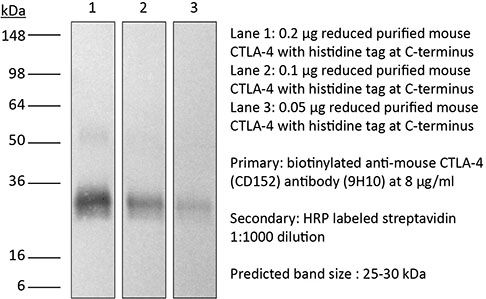
Product Description
Specifications
| Isotype | Syrian hamster IgG |
|---|---|
| Recommended Isotype Control(s) | InVivoMAb polyclonal Syrian hamster IgG |
| Recommended Dilution Buffer | InVivoPure pH 7.0 Dilution Buffer |
| Conjugation | This product is unconjugated. Conjugation is available via our Antibody Conjugation Services. |
| Immunogen | Mouse CTLA-4-human IgG1 fusion protein |
| Reported Applications |
in vivo CTLA-4 neutralization in vitro CTLA-4 neutralization Western blot |
| Formulation |
PBS, pH 7.0 Contains no stabilizers or preservatives |
| Endotoxin |
≤1EU/mg (≤0.001EU/μg) Determined by LAL assay |
| Purity |
≥95% Determined by SDS-PAGE |
| Sterility | 0.2 µm filtration |
| Production | Purified from cell culture supernatant in an animal-free facility |
| Purification | Protein G |
| RRID | AB_10950184 |
| Molecular Weight | 150 kDa |
| Storage | The antibody solution should be stored at the stock concentration at 4°C. Do not freeze. |
| Need a Custom Formulation? | See All Antibody Customization Options |
Application References
-
Bartkowiak, T., et al (2015). "Unique potential of 4-1BB agonist antibody to promote durable regression of HPV+ tumors when combined with an E6/E7 peptide vaccine" Proc Natl Acad Sci U S A 112(38): E5290-5299.
PubMed
Antibody modulation of T-cell coinhibitory (e.g., CTLA-4) or costimulatory (e.g., 4-1BB) receptors promotes clinical responses to a variety of cancers. Therapeutic cancer vaccination, in contrast, has produced limited clinical benefit and no curative therapies. The E6 and E7 oncoproteins of human papilloma virus (HPV) drive the majority of genital cancers, and many oropharyngeal tumors. We discovered 15-19 amino acid peptides from HPV-16 E6/E7 for which induction of T-cell immunity correlates with disease-free survival in patients treated for high-grade cervical neoplasia. We report here that intranasal vaccination with these peptides and the adjuvant alpha-galactosylceramide elicits systemic and mucosal T-cell responses leading to reduced HPV(+) TC-1 tumor growth and prolonged survival in mice. We hypothesized that the inability of these T cells to fully reject established tumors resulted from suppression in the tumor microenvironment which could be ameliorated through checkpoint modulation. Combining this E6/E7 peptide vaccine with checkpoint blockade produced only modest benefit; however, coadministration with a 4-1BB agonist antibody promoted durable regression of established genital TC-1 tumors. Relative to other therapies tested, this combination of vaccine and alpha4-1BB promoted the highest CD8(+) versus regulatory FoxP3(+) T-cell ratios, elicited 2- to 5-fold higher infiltration by E7-specific CTL, and evoked higher densities of highly cytotoxic TcEO (T cytotoxic Eomesodermin) CD8 (>70-fold) and ThEO (T helper Eomesodermin) CD4 (>17-fold) T cells. These findings have immediate clinical relevance both in terms of the direct clinical utility of the vaccine studied and in illustrating the potential of 4-1BB antibody to convert therapeutic E6/E7 vaccines already in clinical trials into curative therapies.
-
Krummey, S. M., et al (2014). "Candida-elicited murine Th17 cells express high Ctla-4 compared with Th1 cells and are resistant to costimulation blockade" J Immunol 192(5): 2495-2504.
PubMed
Effector and memory T cells may cross-react with allogeneic Ags to mediate graft rejection. Whereas the costimulation properties of Th1 cells are well studied, relatively little is known about the costimulation requirements of microbe-elicited Th17 cells. The costimulation blocker CTLA-4 Ig has been ineffective in the treatment of several Th17-driven autoimmune diseases and is associated with severe acute rejection following renal transplantation, leading us to investigate whether Th17 cells play a role in CD28/CTLA-4 blockade-resistant alloreactivity. We established an Ag-specific model in which Th1 and Th17 cells were elicited via Mycobacterium tuberculosis and Candida albicans immunization, respectively. C. albicans immunization elicited a higher frequency of Th17 cells and conferred resistance to costimulation blockade following transplantation. Compared with the M. tuberculosis group, C. albicans-elicited Th17 cells contained a higher frequency of IL-17(+)IFN-gamma(+) producers and a lower frequency of IL-10(+) and IL-10(+)IL-17(+) cells. Importantly, Th17 cells differentially regulated the CD28/CTLA-4 pathway, expressing similarly high CD28 but significantly greater amounts of CTLA-4 compared with Th1 cells. Ex vivo blockade experiments demonstrated that Th17 cells are more sensitive to CTLA-4 coinhibition and therefore less susceptible to CTLA-4 Ig. These novel insights into the differential regulation of CTLA-4 coinhibition on CD4(+) T cells have implications for the immunomodulation of pathologic T cell responses during transplantation and autoimmunity.
-
Quezada, S. A., et al (2010). "Tumor-reactive CD4(+) T cells develop cytotoxic activity and eradicate large established melanoma after transfer into lymphopenic hosts" J Exp Med 207(3): 637-650.
PubMed
Adoptive transfer of large numbers of tumor-reactive CD8(+) cytotoxic T lymphocytes (CTLs) expanded and differentiated in vitro has shown promising clinical activity against cancer. However, such protocols are complicated by extensive ex vivo manipulations of tumor-reactive cells and have largely focused on CD8(+) CTLs, with much less emphasis on the role and contribution of CD4(+) T cells. Using a mouse model of advanced melanoma, we found that transfer of small numbers of naive tumor-reactive CD4(+) T cells into lymphopenic recipients induces substantial T cell expansion, differentiation, and regression of large established tumors without the need for in vitro manipulation. Surprisingly, CD4(+) T cells developed cytotoxic activity, and tumor rejection was dependent on class II-restricted recognition of tumors by tumor-reactive CD4(+) T cells. Furthermore, blockade of the coinhibitory receptor CTL-associated antigen 4 (CTLA-4) on the transferred CD4(+) T cells resulted in greater expansion of effector T cells, diminished accumulation of tumor-reactive regulatory T cells, and superior antitumor activity capable of inducing regression of spontaneous mouse melanoma. These findings suggest a novel potential therapeutic role for cytotoxic CD4(+) T cells and CTLA-4 blockade in cancer immunotherapy, and demonstrate the potential advantages of differentiating tumor-reactive CD4(+) cells in vivo over current protocols favoring in vitro expansion and differentiation.
-
Twyman-Saint Victor, C., et al (2015). "Radiation and dual checkpoint blockade activate non-redundant immune mechanisms in cancer" Nature 520(7547): 373-377.
PubMed
Immune checkpoint inhibitors result in impressive clinical responses, but optimal results will require combination with each other and other therapies. This raises fundamental questions about mechanisms of non-redundancy and resistance. Here we report major tumour regressions in a subset of patients with metastatic melanoma treated with an anti-CTLA4 antibody (anti-CTLA4) and radiation, and reproduced this effect in mouse models. Although combined treatment improved responses in irradiated and unirradiated tumours, resistance was common. Unbiased analyses of mice revealed that resistance was due to upregulation of PD-L1 on melanoma cells and associated with T-cell exhaustion. Accordingly, optimal response in melanoma and other cancer types requires radiation, anti-CTLA4 and anti-PD-L1/PD-1. Anti-CTLA4 predominantly inhibits T-regulatory cells (Treg cells), thereby increasing the CD8 T-cell to Treg (CD8/Treg) ratio. Radiation enhances the diversity of the T-cell receptor (TCR) repertoire of intratumoral T cells. Together, anti-CTLA4 promotes expansion of T cells, while radiation shapes the TCR repertoire of the expanded peripheral clones. Addition of PD-L1 blockade reverses T-cell exhaustion to mitigate depression in the CD8/Treg ratio and further encourages oligoclonal T-cell expansion. Similarly to results from mice, patients on our clinical trial with melanoma showing high PD-L1 did not respond to radiation plus anti-CTLA4, demonstrated persistent T-cell exhaustion, and rapidly progressed. Thus, PD-L1 on melanoma cells allows tumours to escape anti-CTLA4-based therapy, and the combination of radiation, anti-CTLA4 and anti-PD-L1 promotes response and immunity through distinct mechanisms.
Product Citations
-
Flt3L-mediated tumor cDC1 expansion enhances immunotherapy by priming stem-like CD8+ T cells in lymph nodes.
In Nat Immunol on 1 March 2026 by Lai, J., Chan, C. W., et al.
PubMed
Immune checkpoint blockade (ICB) evokes antitumor immunity through the reinvigoration of T cell responses. T cell differentiation status controls response, with less differentiated cells having an enhanced capacity to proliferate after ICB. Given that conventional type 1 dendritic cells (cDC1) maintain precursor exhausted T cells (TPEX), we hypothesized that expansion of cDC1s with Flt3L could enhance responses to ICB. Here we show that treatment with Fms-related tyrosine kinase 3 ligand (Flt3L) expands CD62L+SLAMF6+CD8+ T cells in the tumor through a mechanism that requires XCR1+ dendritic cells to traffic to the tumor-draining lymph node. The combination of Flt3L and anti-CTLA-4 enhanced therapeutic responses. Combination therapy is associated with the emergence of a CD8+ T cell subset characterized by the expression of Il21r and oligoclonal expansion of CD8+ T cells within tumors through a mechanism that is dependent on lymph node egress.
-
Mesothelioma location influences the tumour microenvironment and immune checkpoint therapy response in preclinical models.
In Sci Rep on 25 February 2026 by Orozco Morales, M. L., Lansley, S. M., et al.
PubMed
-
Oral immunization with Listeria monocytogenes vaccine enhances immunotherapy for protective immunity in murine models of colorectal cancer.
In J Immunother Cancer on 5 February 2026 by Lei, X., Yu, Y., et al.
PubMed
Colorectal cancer (CRC) is a leading cause of cancer-related death and remains a significant global health challenge. Cancer vaccines have emerged as a promising immunotherapy for long-term tumor control. While Listeria monocytogenes (Lm)-based intravenous vaccines can generate tumor-reactive CD8 T cells, clinical trial success has been limited. Here, we sought to determine whether in vivo targeting of gastrointestinal tissues with foodborne delivery of Lm-based cancer vaccines controlled tumor growth in murine models of CRC.
-
In situ self-assembled cell reservoir hydrogel for maneuvering multistage radioimmunotherapy.
In Nat Commun on 21 January 2026 by Chen, Y., Chen, Q., et al.
PubMed
Radiotherapy (RT) is a clinical mainstay of cancer treatment that triggers tumor-specific immune responses. However, the effectiveness is usually hampered due to the hypoxic tumor microenvironment (TME) and the ambivalent impact of RT on the immune landscape of tumors. Herein, we develop an injectable hydrogel encapsulating interleukin-12 (IL-12)/anti-CTLA-4 (aCTLA-4) co-engineered red blood cells (RBC), which is in situ self-assembled within the TME to increase oxygen supply and instigate sequential aCTLA-4/IL-12 release, thus achieving Ba/O2 self-compensated radiosensitization and activating multistage immune responses. Once in the acidic TME, the in situ injected BaO2 undergoes hydrolysis to generate H2O2 and Ba2+, followed by the rapid reaction of Ba2+ with sodium alginate to afford a biocompatible hydrogel. Meanwhile, catalase presented on RBC converts H2O2 into O2, thereby alleviating hypoxia-induced radioresistance and inducing O2-mediated pore formation on RBC membrane for rapid release of aCTLA-4 to relieve tumor immunosuppression. Subsequently, IL-12 anchored on RBC is dilatorily released and interacts with T/NK cells within the TME to induce IFN-γ-dependent antitumor immunity. Taken together, the in situ self-assembled cell reservoir hydrogel offers a futuristic avenue to realize multistage radioimmunotherapy for effective tumor regression by programmable immunoregulation with significant clinical value.